
Global Advanced Surface Movement Guidance Control System Market — Forecast to 2032
Research scope: By System Type (Surveillance Systems, Routing Systems, Guidance Systems, Control Systems), By Component (Radar Sensors, Software, Control Towers Equipment, Multilateration Systems), By Airport Category (Category A Airports, Category B Airports, Category C Airports), By Application (Commercial Airports, Military Airbases, Cargo and Freight Airports), By End User (Airport Authorities, Air Navigation Service Providers, Defense Agencies)
Domain: Aerospace & Defense
Report Code: MIADG 10009
Advanced Surface Movement Guidance Control System Market Analysis and Insights:
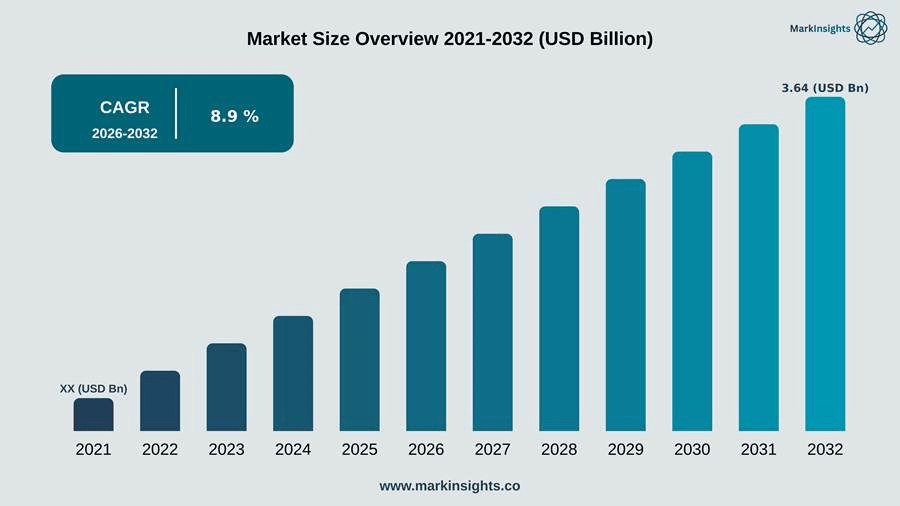
The global Advanced Surface Movement Guidance Control System market was valued at approximately USD 2.18 billion in 2026 and is projected to reach around USD 3.64 billion by 2032, registering a CAGR of approximately 8.9% during the 2026-2032 forecast period.
Growth is anchored by rising global air traffic volumes that are pushing congested hub airports toward mandatory surface movement automation to prevent runway incursions and taxiway conflicts, alongside continuous regulatory pressure from aviation safety authorities to modernize ground movement surveillance infrastructure at Category A and Category B airports. Indra Sistemas, Saab, and Thales have secured multi-year airport modernization contracts across Europe, the Middle East, and Asia Pacific that are anchoring sustained system deployment demand through the forecast period.
The competitive landscape is consolidating around a small group of radar, avionics, and air traffic management integrators that collectively dominate large-hub deployments. Saab acquired BlueBear Systems Research in February 2024 to strengthen its autonomous surface surveillance capabilities, Thales expanded its air traffic management partnership with Airways New Zealand in June 2025 to deploy next-generation surface guidance infrastructure, Indra Sistemas won a multi-airport advanced surface movement guidance and control system upgrade contract across Latin America in late 2024, and Leonardo advanced its multilateration-based ground surveillance rollout across Italian regional airports in 2025. Europe led 2026 revenue, while Asia Pacific is the fastest-growing region led by China, India, and Southeast Asia.
Advanced Surface Movement Guidance Control System Market Definition:
An Advanced Surface Movement Guidance Control System is an integrated air traffic management technology suite deployed at airports to provide continuous surveillance, routing guidance, and conflict alerting for aircraft and ground vehicles operating on runways, taxiways, and apron areas, particularly under low-visibility conditions. The system architecture typically combines primary and secondary surface movement radar, multilateration sensor networks, automatic dependent surveillance broadcast receivers, and integrated software platforms that fuse positional data into a unified situational display for air traffic controllers. Core functional modules include surveillance systems that detect and track aircraft and vehicle positions across the maneuvering area, routing systems that generate optimized taxi paths, guidance systems that provide pilots and vehicle operators with visual or electronic cues for safe navigation, and control systems that issue automated conflict alerts and runway incursion warnings to controllers. These systems are deployed primarily at Category A and Category B commercial hub airports handling high traffic density, military airbases requiring secure ground movement coordination, and cargo and freight airports where efficient apron management directly affects turnaround times. Airport authorities, air navigation service providers, and defense agencies rely on these systems to reduce ground collision risk, improve runway throughput capacity, and maintain operational continuity during periods of reduced visibility such as fog or heavy precipitation.
Advanced Surface Movement Guidance Control System Market Research Methodology:
The demand-side assessment was built bottom-up from primary interviews with business buyers active in the advanced surface movement guidance control system market, including institutional and industrial procurement buyers, distributors, and institutional or industrial purchasers, etc., and cross-referenced against demand-side secondary sources such as public production and consumption data, industry and trade-association surveys, etc. On the supply side, estimates were developed top-down from primary interviews with raw-material and component suppliers and with commercial leadership at manufacturers, etc., supported by secondary sources including publicly disclosed revenue and volume commentary from companies such as Thales, Saab, and Leonardo (10-K filings, investor presentations, and primary research transcripts), the regulatory frameworks of [RELEVANT REGULATOR — none detected in spec], and relevant import-export trade records, etc. Leading research typically incorporates 100-130 structured B2B interviews per report, split across institutional and industrial procurement buyers, component and raw-material suppliers, and tier-1 manufacturers, weighted toward the report's central growth regions. For this report, core inputs were cross-referenced against [RELEVANT REGULATOR] filings and publicly disclosed manufacturer segment data relevant to the Advanced Surface Movement Guidance Control System category.
Advanced Surface Movement Guidance Control System Market Size, Scope & Segmentation:
| Report Attribute | Details |
| Market size in 2026 | USD 2.18 billion |
| Market Size by 2032 | USD 3.64 billion |
| Global CAGR (2026-2032) | 8.9% |
| Historical Data | 2021-2024 |
| Forecast Period | 2026-2032 |
| Segments Covered | By System Type • Surveillance Systems • Routing Systems • Guidance Systems • Control Systems By Component • Radar Sensors • Software • Control Towers Equipment • Multilateration Systems By Airport Category • Category A Airports • Category B Airports • Category C Airports By Application • Commercial Airports • Military Airbases • Cargo and Freight Airports By End User • Airport Authorities • Air Navigation Service Providers • Defense Agencies |
| Regions and Countries Covered | North America • US • Canada • Mexico Europe • Germany • UK • France • Italy • Spain • Rest of Europe Asia Pacific • China • India • Japan • South Korea • Australia • Rest of Asia Pacific Middle East and Africa • Saudi Arabia • UAE • South Africa • Rest of Middle East and Africa South America • Brazil • Argentina • Rest of South America |
| Market leaders and key company profiles | Thales Saab Leonardo Indra Sistemas Raytheon Technologies Frequentis Terma Searidge Technologies ADB SAFEGATE Honeywell Northrop Grumman Kongsberg Gruppen Cambridge Pixel Era Corporation Comsoft Solutions |
Advanced Surface Movement Guidance Control System Key Market Segmentation:
Insights On Key System Type
The system type segment encompasses surveillance systems (the dominant sub-category, comprising surface movement radar, multilateration networks, and automatic dependent surveillance broadcast integration from Saab, Thales, and Indra Sistemas that provide continuous position tracking across runways and taxiways), routing systems (a growing sub-category that computes optimal taxi routes and sequencing to reduce ground delay and fuel burn), guidance systems (including stop bar lighting control and pilot guidance displays from Honeywell and Leonardo that direct aircraft movement under low-visibility conditions), and control systems (encompassing conflict alerting, runway incursion warning, and controller decision-support software integrated into tower workstations).
Surveillance systems dominate the system type sub-segment because accurate, continuous position tracking of every aircraft and vehicle on the maneuvering area is the foundational data layer that routing, guidance, and control functions depend upon, making radar and multilateration sensor procurement the first and largest line item in any airport's advanced surface movement guidance and control system upgrade program.
Insights On Key Component
The component segment covers radar sensors (the largest hardware sub-category, including surface movement radar and multilateration transceivers supplied by Saab, Thales, and Leonardo that form the physical detection infrastructure), software (a rapidly growing sub-category encompassing data fusion, conflict-alerting algorithms, and controller display platforms from Indra Sistemas and Frequentis that convert sensor data into actionable situational awareness), control towers equipment (including integrated controller workstations, communication panels, and visual display consoles), and multilateration systems (a distinct sensor category using time-difference-of-arrival positioning that complements radar in areas with line-of-sight limitations).
Radar sensors lead the component sub-segment because primary and secondary surface movement radar remains the mandatory baseline sensor technology specified in most Category A airport tenders, and the high unit cost and long replacement cycle of radar hardware relative to software licensing keeps this component category as the largest revenue contributor across system deployments.
Insights On Key Airport Category
The airport category segment includes Category A airports (the leading sub-category, comprising the largest international hubs with high daily movement counts and frequent low-visibility operations that mandate the most comprehensive surveillance and control system configurations), Category B airports (mid-tier regional and secondary international airports adopting scaled-down surface movement guidance suites as traffic grows), and Category C airports (smaller regional and domestic airports where basic surveillance capability is increasingly justified by safety regulation rather than traffic volume alone).
Category A airports dominate the airport category sub-segment because these hubs experience the highest runway and taxiway movement density combined with the greatest exposure to fog, low-visibility, and mixed aircraft-vehicle traffic, making comprehensive surveillance, routing, guidance, and control system integration a near-universal safety and capacity requirement rather than a discretionary upgrade.
Insights On Key Application
The application segment spans commercial airports (the dominant sub-category, encompassing passenger hub and regional airport deployments driven by rising air traffic volumes and runway incursion prevention mandates), military airbases (a steady sub-category where defense agencies deploy secure, ruggedized surface movement systems to coordinate mixed fixed-wing, rotary-wing, and ground vehicle operations), and cargo and freight airports (a growing sub-category where efficient apron sequencing and ground vehicle tracking directly reduce aircraft turnaround time and improve cargo throughput).
Commercial airports lead the application sub-segment because global passenger traffic recovery and continued fleet growth are placing sustained pressure on hub airport ground capacity, driving airport authorities and air navigation service providers to prioritize advanced surface movement guidance and control system procurement as a direct enabler of increased runway throughput.
Insights On Key End User
The end user segment covers airport authorities (the largest sub-category, comprising individual airport operators that procure and maintain surface movement systems as part of broader airfield infrastructure investment programs), air navigation service providers (national and regional bodies such as NATS, DFS, and Airways New Zealand that operate surveillance and control systems on behalf of multiple airports under service contracts), and defense agencies (military branches procuring ruggedized systems for airbase ground movement coordination and force protection).
Airport authorities lead the end user sub-segment because capital budgeting for surface movement infrastructure typically resides directly with the airport operator, giving these entities primary procurement authority over system specification, vendor selection, and phased upgrade scheduling across terminal expansion and runway capacity projects.
Insights on Regional Analysis
The global Advanced Surface Movement Guidance Control System market spans North America, Europe, Asia Pacific, Middle East and Africa, and South America. Europe leads global revenue, anchored by major hub airports in the United Kingdom, Germany, France, and the Netherlands operating under European Union Aviation Safety Agency (EASA) certification specifications and Eurocontrol network operational requirements that mandate advanced surveillance and conflict-alerting capability at high-density international airports. Thales, Indra Sistemas, Saab, and Frequentis maintain substantial European manufacturing and systems integration operations, supplying both domestic hub upgrades and export contracts across the Middle East and Asia. National air navigation service providers including DFS Deutsche Flugsicherung and NATS in the United Kingdom continue phased modernization of surface surveillance infrastructure at their busiest hub airports, reinforcing sustained regional procurement activity. Continued airport capacity expansion projects across Germany and France, coupled with EASA runway safety directives following recent incursion incident reviews, are sustaining upgrade cycles at both primary and secondary European hubs.
Asia Pacific is the fastest-growing region for Advanced Surface Movement Guidance Control System deployment, led by China, India, and Southeast Asia. China's Civil Aviation Administration of China (CAAC) is overseeing rapid new airport construction and existing hub capacity expansion across the country, creating substantial greenfield demand for integrated surveillance and control system procurement from both domestic and international suppliers. India's Airports Authority of India is modernizing ground movement infrastructure at major metropolitan airports under the national airport capacity expansion program, supported by the Directorate General of Civil Aviation's runway safety oversight requirements. Southeast Asian nations including Indonesia, Thailand, and Vietnam are investing in new international gateway airports and secondary hub upgrades to accommodate rising regional air travel demand, with Thales, Saab, and Leonardo actively pursuing systems integration contracts across the region. Rising low-cost carrier traffic volumes and new airport openings across the region are compelling national aviation authorities to accelerate advanced surface movement guidance and control system adoption ahead of anticipated future congestion.
Advanced Surface Movement Guidance Control System Market Company Profiles:
The Advanced Surface Movement Guidance Control System competitive landscape encompasses three primary archetypes: global air traffic management and defense integrators (Thales, Saab, Leonardo, Indra Sistemas, Raytheon Technologies) that supply complete surveillance, routing, and control system suites to major international hub airports and military customers worldwide; specialist air navigation systems software and communications providers (Frequentis, Terma, Searidge Technologies, ADB SAFEGATE) that focus on data fusion software, controller workstations, and airfield lighting guidance integration; and radar and sensor component manufacturers (Honeywell, Northrop Grumman, Kongsberg Gruppen, Cambridge Pixel, Era Corporation) that supply the underlying surveillance hardware and multilateration technology integrated into larger system deployments.
The 15 anchor companies profiled in this report are Thales, Saab, Leonardo, Indra Sistemas, Raytheon Technologies, Frequentis, Terma, Searidge Technologies, ADB SAFEGATE, Honeywell, Northrop Grumman, Kongsberg Gruppen, Cambridge Pixel, Era Corporation, and Comsoft Solutions. Thales supplies integrated surface movement surveillance and control systems to major international hub airports across Europe, the Middle East, and Asia Pacific. Saab provides surface movement radar and multilateration-based surveillance systems, reinforced by its acquisition of BlueBear Systems Research to expand autonomous surveillance capability. Indra Sistemas has secured multi-airport advanced surface movement guidance and control system upgrade contracts across Latin America and Europe. Frequentis specializes in air traffic management software platforms that fuse surveillance data into controller decision-support displays. ADB SAFEGATE focuses on airfield lighting and guidance system integration for low-visibility ground movement operations. Terma and Cambridge Pixel hold specialist radar signal-processing positions serving mid-tier regional airport upgrade programs.
Advanced Surface Movement Guidance Control System Market Latest Trends and Innovation:
• In June 2025, Thales expanded its long-term air traffic management partnership with Airways New Zealand to deploy next-generation surface movement surveillance and controller decision-support infrastructure across major New Zealand airports, extending an existing collaboration focused on improving runway safety and ground traffic capacity under increasing air travel demand.
• In February 2025, Saab announced the completion of its acquisition of BlueBear Systems Research, a UK-based autonomous systems developer, strengthening Saab's capability to integrate autonomous and semi-autonomous ground surveillance functions into its airport surface movement radar and multilateration product lines for both civil and defense customers.
• In November 2024, Indra Sistemas was awarded a contract to upgrade advanced surface movement guidance and control system infrastructure across multiple Latin American international airports, covering surveillance radar replacement, multilateration sensor installation, and controller workstation software modernization to support rising regional air traffic volumes.
• In March 2024, Leonardo commenced deployment of multilateration-based ground surveillance systems across a group of Italian regional airports, working with national air navigation service provider ENAV to extend low-visibility surface movement guidance coverage beyond the country's largest hub airports into secondary domestic gateways.
Advanced Surface Movement Guidance Control System Market Significant Growth Factors:
The global Advanced Surface Movement Guidance Control System market is expanding on the back of four reinforcing drivers. Rising global passenger and cargo air traffic volumes are increasing runway and taxiway movement density at major hub airports, compelling airport authorities to invest in comprehensive surveillance and conflict-alerting infrastructure to sustain safe throughput. Regulatory pressure from aviation safety authorities including EASA and the US FAA following high-profile runway incursion incidents is accelerating mandatory upgrade cycles at Category A and Category B airports across multiple regions. Continued expansion of new international gateway airports across China, India, and Southeast Asia is generating substantial greenfield procurement opportunities for complete surveillance, routing, guidance, and control system suites. Growing integration of automatic dependent surveillance broadcast and multilateration sensor networks with legacy primary radar infrastructure is enabling airports to achieve more comprehensive low-visibility coverage without full system replacement, lowering the total cost of phased modernization and broadening the addressable customer base beyond only the largest, best-funded hub operators.
Advanced Surface Movement Guidance Control System Market Drivers:
Demand is driven by air traffic growth, runway safety regulation, low-visibility operational requirements, and airport capacity expansion programs. Sustained recovery and structural growth in global passenger and cargo aviation volumes are increasing the frequency of ground movement conflicts at congested hub airports, directly driving airport authority investment in surveillance, routing, and conflict-alerting system upgrades from Thales, Saab, and Indra Sistemas. Runway safety regulations issued by EASA, the FAA, and the International Civil Aviation Organization following incursion incident investigations are establishing minimum surveillance coverage and controller alerting requirements that compel airport operators to modernize legacy systems on defined regulatory timelines. Airports located in regions with frequent fog, heavy precipitation, or low-visibility weather conditions face operational continuity requirements that make advanced guidance systems a near-mandatory investment rather than a discretionary capacity enhancement. Large-scale new airport construction and existing hub expansion programs across China, India, and the Middle East are embedding advanced surface movement guidance and control system specification directly into greenfield airfield design from project inception.
Advanced Surface Movement Guidance Control System Market Restraining Factors:
Several factors temper growth across the Advanced Surface Movement Guidance Control System value chain. High upfront capital cost of comprehensive surveillance radar, multilateration sensor networks, and integrated software platforms creates significant budgetary barriers for mid-tier and smaller regional airports operating under constrained capital expenditure programs. Long procurement and certification cycles, often extending several years from tender issuance to full operational deployment, delay revenue recognition for system integrators and can result in technology obsolescence risk between contract award and commissioning. Integration complexity when retrofitting advanced surveillance and control capability into existing airport infrastructure with legacy radar or communication systems increases project cost overrun risk and extends implementation timelines beyond original contract schedules. Budget constraints at government-owned airport authorities in developing markets, combined with competing infrastructure investment priorities, are slowing planned upgrade timelines at several Category B and Category C airports despite documented safety justification for system modernization.
Advanced Surface Movement Guidance Control System Market Opportunities:
Opportunities cluster in four pockets across the Advanced Surface Movement Guidance Control System landscape. Retrofit and phased modernization programs at mid-tier Category B airports represent a large underserved market segment where vendors offering modular, incrementally deployable surveillance and software solutions can capture budget-constrained customers unable to fund full system replacement. Integration of artificial intelligence-based conflict prediction and automated routing optimization into existing controller decision-support software offers system integrators including Frequentis and Searidge Technologies a pathway to higher-margin software upgrade revenue on top of installed hardware bases. Rapid new airport construction across China, India, and Southeast Asia provides substantial greenfield deployment opportunities for complete system suites from Thales, Saab, and Leonardo, with long-term maintenance and support contract attachment. Defense sector modernization of military airbase ground movement coordination, particularly at joint civil-military airfields, represents a growing specialized demand segment for ruggedized systems from Raytheon Technologies and Northrop Grumman that require distinct certification and security specifications relative to commercial airport deployments.
Advanced Surface Movement Guidance Control System Market Technology Trends:
Technology direction is set by three converging shifts in Advanced Surface Movement Guidance Control System design and deployment. Sensor fusion architectures that integrate primary surface movement radar, multilateration networks, and automatic dependent surveillance broadcast data into unified positional tracking are enabling Thales and Saab to deliver more accurate and resilient coverage across complex airfield geometries with fewer blind spots than single-sensor legacy configurations. Artificial intelligence and machine learning-based conflict prediction algorithms are being integrated into controller decision-support software by Frequentis and Searidge Technologies to shift from reactive incursion alerting toward predictive risk identification that flags potential conflicts before they materialize on the airfield. Cloud-based and virtualized air traffic management platforms are enabling smaller Category B and Category C airports to access sophisticated surveillance data processing capability without maintaining extensive on-premises computing infrastructure, lowering the technology barrier to modernization for budget-constrained regional operators pursuing phased upgrade strategies.
Advanced Surface Movement Guidance Control System Market Future Trends:
By 2032, the market will be reshaped by three structural shifts: deeper integration of autonomous ground vehicle tracking into surveillance networks, expanded predictive analytics capability across controller workstations, and growing standardization of multilateration as a baseline sensor technology alongside radar. Autonomous and semi-autonomous ground support vehicles, baggage tugs, and de-icing equipment are increasingly being integrated into surface surveillance tracking networks by Saab and Leonardo, requiring system architectures capable of distinguishing and coordinating both piloted and unpiloted ground traffic within a single situational display. Predictive analytics capability embedded directly into controller workstation software from Frequentis and Indra Sistemas is expected to become a standard specification requirement in new airport tenders, moving the market beyond passive surveillance toward proactive capacity and safety management. Multilateration technology, currently deployed primarily as a radar complement, is expected to achieve broader standalone adoption at Category B and Category C airports as sensor costs decline, expanding the addressable market for vendors historically focused on premium Category A hub deployments.
Advanced Surface Movement Guidance Control System Market Supply Chain Analysis:
The Advanced Surface Movement Guidance Control System supply chain runs from radar and sensor component manufacturers through systems integrators to airport authorities and air navigation service providers that operate the deployed infrastructure under long-term maintenance agreements. Upstream component supply is anchored by radar and multilateration sensor manufacturers including Saab, Leonardo, and Cambridge Pixel, alongside specialized software developers such as Frequentis and Terma that provide data fusion and controller display platforms. Systems integrators including Thales, Indra Sistemas, and Raytheon Technologies combine sensor hardware, communication infrastructure, and software into complete turnkey solutions delivered through multi-year airport modernization contracts that typically include installation, certification support, and extended maintenance provisions spanning a decade or more.
Distribution to end customers occurs almost entirely through direct contract award following competitive public tender processes managed by airport authorities or national air navigation service providers, rather than through distributor or reseller networks common in other aerospace segments. Key bottlenecks include lengthy certification and regulatory approval timelines that can extend deployment schedules well beyond initial contract signing, component lead times for specialized radar transceivers during periods of elevated global defense and civil aviation procurement demand, and integration risk when new systems must interoperate with heterogeneous legacy air traffic management infrastructure already installed at brownfield airport sites.
Advanced Surface Movement Guidance Control System Market Regulatory Analysis:
The global Advanced Surface Movement Guidance Control System market operates within a stringent aviation safety regulatory framework governing surveillance performance, certification, and interoperability standards across major markets. Principal regulatory anchors include the European Union Aviation Safety Agency (EASA) certification specifications for ground-based surveillance equipment and Eurocontrol network operational requirements applicable across European Union member states, the US Federal Aviation Administration (FAA) Advisory Circulars governing airport surface detection equipment performance standards, and International Civil Aviation Organization (ICAO) Annex 14 aerodrome design and operations standards that establish baseline surface movement guidance requirements applicable globally. National civil aviation authorities including the Civil Aviation Administration of China (CAAC), India's Directorate General of Civil Aviation, and the UK Civil Aviation Authority impose additional domestic certification and safety case approval requirements before new systems can enter operational service. Conformity assessment routes typically require system-level safety case documentation, factory acceptance testing, and site acceptance testing prior to operational commissioning, with ongoing compliance monitored through periodic safety audits and mandatory incident reporting to national aviation safety authorities.
Advanced Surface Movement Guidance Control System Market Share Analysis:
The top five vendors together account for an estimated 60-70% of global Advanced Surface Movement Guidance Control System revenue in the Category A hub airport segment, with the remainder distributed across specialist software providers, regional systems integrators, and radar component manufacturers serving mid-tier and secondary airports. Concentration is highest in the large international hub upgrade segment where Thales, Saab, Leonardo, Indra Sistemas, and Raytheon Technologies collectively dominate through long-term integration contracts, while the market is most fragmented in the Category B and Category C regional airport segment served by smaller specialist software and sensor suppliers.
Advanced Surface Movement Guidance Control System Market Competitive Landscape:
The Advanced Surface Movement Guidance Control System competitive landscape is led by Thales, Saab, Leonardo, Indra Sistemas, and Raytheon Technologies, with significant presence from Frequentis, Terma, Searidge Technologies, ADB SAFEGATE, Honeywell, Northrop Grumman, Kongsberg Gruppen, Cambridge Pixel, Era Corporation, and Comsoft Solutions. The Saab acquisition of BlueBear Systems Research in February 2025, the Thales-Airways New Zealand partnership expansion in June 2025, the Indra Sistemas Latin American contract award in November 2024, and the Leonardo Italian regional airport deployment in March 2024 are the principal developments shaping the competitive map.
Key Player Strategies
Leaders are prioritizing long-term airport authority framework agreements, sensor fusion technology investment, and expansion into predictive analytics-based controller decision support to differentiate beyond traditional hardware supply. Thales and Saab compete on global systems integration scale and radar technology depth, while Frequentis and Searidge Technologies focus on software-driven controller workstation innovation. This parameter analyses the strategic posture of each leading player across technology integration, contract structure, and geographic expansion dimensions.
Buyer-Tier Concentration
Concentration differs sharply by buyer tier across this market. Tier-1 buyers, comprising the largest international hub airport authorities and national air navigation service providers such as NATS and DFS Deutsche Flugsicherung, consolidate procurement almost exclusively with Thales, Saab, Leonardo, and Indra Sistemas because only these integrators can deliver certified, fully redundant systems at the scale and reliability these operators require. Mid-tier regional airport authorities, by contrast, are increasingly served through specialist software and sensor suppliers such as Frequentis and Cambridge Pixel offering modular, lower-cost deployments, which meaningfully dilutes the effective concentration figure at the broader market level even though the largest integrators retain dominant share among the highest-value hub contracts.
Company Capability Assessment
Capability leadership is differentiated by segment and geography: Thales leads in integrated surveillance and control system deployment across major European and Middle Eastern hub airports; Saab leads in surface movement radar and autonomous surveillance integration following its BlueBear Systems Research acquisition; Indra Sistemas leads in Latin American and Iberian regional multi-airport upgrade programs; Leonardo leads in multilateration-based surveillance deployment across Italian and broader Mediterranean regional airports; Frequentis leads in air traffic management software and controller decision-support platform development. This parameter covers each leader's depth across sensor technology, software capability, and regional systems integration presence.
Market Concentration
The top five vendors account for an estimated 60-70% of global Advanced Surface Movement Guidance Control System revenue in the Category A hub airport segment, reflecting high concentration driven by capital-intensive systems integration requirements and long-term airport authority contract relationships. This parameter covers the degree of vendor concentration relative to total addressable market revenue.
Frequently Asked Questions
How big is the Advanced Surface Movement Guidance Control System Market and what will it be worth by 2032?
The Advanced Surface Movement Guidance Control System Market was valued at approximately USD 2.18 billion in 2026 and is projected to reach around USD 3.64 billion by 2032, registering a CAGR of approximately 8.9%.
What is the CAGR of the Advanced Surface Movement Guidance Control System Market from 2026 to 2032?
The Advanced Surface Movement Guidance Control System Market is projected to register a CAGR of approximately 8.9% during the forecast period from 2026 to 2032.
What are the key drivers and restraints shaping the Advanced Surface Movement Guidance Control System Market?
Key Drivers:
• Sustained recovery and structural growth in global passenger and cargo aviation volumes are increasing the frequency of ground movement conflicts at congested hub airports, directly driving airport authority investment in surveillance, routing, and conflict-alerting system upgrades from Thales, Saab, and Indra Sistemas.
• Runway safety regulations issued by EASA, the FAA, and the International Civil Aviation Organization following incursion incident investigations are establishing minimum surveillance coverage and controller alerting requirements that compel airport operators to modernize legacy systems on defined regulatory timelines.
Key Restraints:
• High upfront capital cost of comprehensive surveillance radar, multilateration sensor networks, and integrated software platforms creates significant budgetary barriers for mid-tier and smaller regional airports operating under constrained capital expenditure programs.
• Long procurement and certification cycles, often extending several years from tender issuance to full operational deployment, delay revenue recognition for system integrators and can result in technology obsolescence risk between contract award and commissioning.
What are the major segments and which region leads the Advanced Surface Movement Guidance Control System Market?
Surveillance systems (System Type), Radar sensors (Component), Category A airports (Airport Category), Commercial airports (Application), Airport authorities (End User) lead their respective segments. Europe leads global revenue, anchored by major hub airports in the United Kingdom, Germany, France, and the Netherlands operating under European Union Aviation Safety Agency (EASA). Asia Pacific is the fastest-growing region, led by China, India, and Southeast Asia. Full segment-level analysis, including growth drivers, restraints, and country-level detail for every region covered in this study, is provided in the corresponding chapters of the full report.
Who are the leading companies in the Advanced Surface Movement Guidance Control System Market?
The top five players in the Advanced Surface Movement Guidance Control System Market — Thales, Saab, Leonardo, Indra Sistemas, and Raytheon Technologies — collectively hold an estimated 60-70% of global revenue. Key companies covered in this report include Thales, Saab, Leonardo, Indra Sistemas, Raytheon Technologies, Frequentis, Terma, Searidge Technologies, ADB SAFEGATE, Honeywell, Northrop Grumman, Kongsberg Gruppen, Cambridge Pixel, Era Corporation, and Comsoft Solutions.
Related Reports
Global Aircraft Ground Handling System Market — Forecast to 2032
By Equipment Type (Ground Power Units, Ground Support Vehicles, Baggage and Cargo Handling Systems, De-Icing Equipment, Passenger Boarding Bridges and Stairs), By Service Type (Ramp Handling, Cargo and Baggage Handling, De-Icing Services, Passenger Handling, Aircraft Marshalling), By Application (Commercial Aviation, Military Aviation, Cargo and Freight), By Power Source (Electric, Diesel/Fuel-Powered, Hybrid), By End User (Airports, Airlines, Third-Party Ground Handling Service Providers)
From $ 2,500
View Report →Global 5G Market Aviation Market — Forecast to 2032
By Component (Hardware, Software, Services), By Connectivity Type (In-Flight Connectivity, Air-to-Ground Connectivity, Satellite-Based Connectivity), By Application (Passenger Connectivity, Aircraft Operations and Maintenance, Air Traffic Management, Cargo and Logistics Tracking), By Platform (Commercial Aviation, Military Aviation, Business and General Aviation, Unmanned Aerial Vehicles)
From $ 2,500
View Report →