
Global Fiber Optics Collimating Lens Market- Forecast to 2032
Research scope: By Type (Fixed, Adjustable), By Mode (Single Mode, Multimode), By Application (Communication, Medical and Diagnostics, Metrology, Industrial Automation, Others)
Domain: Semiconductor & Electronics
Report Code: MISEG 11095
Fiber Optics Collimating Lens Market Analysis and Insights:
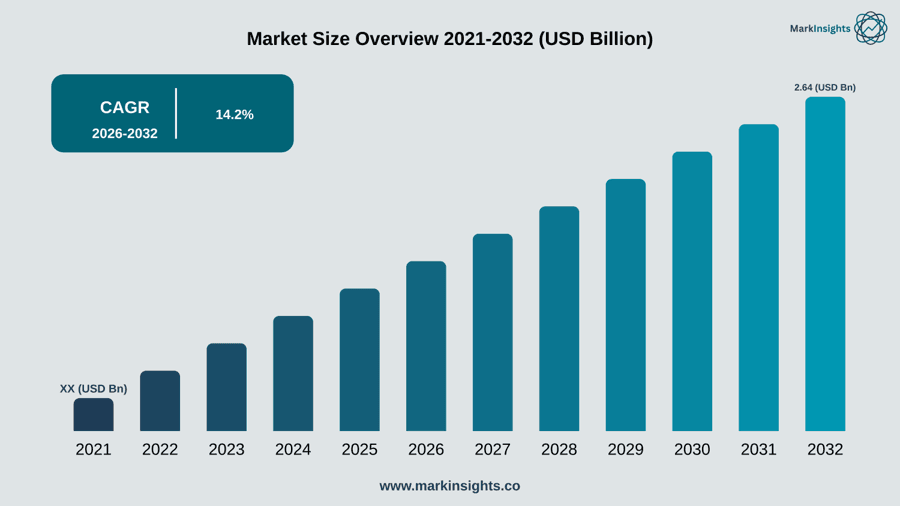
The global Fiber Optics Collimating Lens market was valued at approximately USD 1.19 billion in 2026 and is projected to reach around USD 2.64 billion by 2032, registering a CAGR of approximately 14.2% during the 2026-2032 forecast period.
Growth is anchored by accelerating demand for high-density optical transceiver collimator components in 400G and 800G data center interconnect, the expanding adoption of fiber collimating optics in LiDAR sensor systems for autonomous vehicles and industrial robotics, and the proliferation of quantum computing and quantum sensing programs requiring ultra-precision polarization-maintaining fiber collimators (SABIC launched a new polyetherimide resin specifically suited for optical transceiver collimator lens fabrication and single mode fiber alignment in August 2024, reinforcing material innovation as a key performance driver). Tier-1 photonics manufacturers and specialty optical component suppliers are scaling aspheric and graded-index collimator production to support 5G coherent optics, medical diagnostic imaging, and precision metrology applications.
The competitive landscape is consolidating around high-density collimator array development for optical circuit switching, data-center-grade aspheric lens scaling, and precision polymer material innovation for fiber-coupled lens assemblies. Coherent Corp. launched its 2D Collimator Array for optical circuit switches at OFC in March 2025, SABIC launched polyetherimide resin for optical transceiver collimator lens fabrication in August 2024, Thorlabs released a new pulsed laser platform integrating precision fiber collimation for LIDAR and metrology applications in April 2024, and Thorlabs expanded its polarization-maintaining fiber collimator product line for quantum sensing and photonic chip integration in November 2023. North America led 2026 revenue, while Asia Pacific is the fastest-growing region led by China, Japan, and South Korea.
Market Definition
Fiber Optics Collimating Lenses are precision optical elements designed to convert divergent light emerging from the end face of an optical fiber into a parallel or near-parallel collimated beam with controlled wavefront quality, or conversely to focus a collimated free-space beam into a fiber core with high coupling efficiency. Core lens technology architectures include fixed collimators featuring aspheric, graded-index, or ball-lens elements permanently aligned to a fiber ferrule at a defined working wavelength for stable, maintenance-free deployment in communications transceivers and optical sub-assemblies, adjustable collimators enabling variable working distance and beam diameter tuning via mechanical focus adjustment for laboratory, sensing, and multi-wavelength instrument applications, single mode fiber collimators optimized for diffraction-limited beam quality at telecom wavelengths between 850 nm and 1625 nm for coherent optical communications and precision metrology, and polarization-maintaining fiber collimators preserving fiber polarization state in the collimated output for quantum optics, gyroscope sensing, and coherent detection systems. These components are deployed across coherent optical transceivers, free-space optical communications terminals, LiDAR range-finding modules, laser material processing delivery optics, medical endoscopy and diagnostic instrument probe assemblies, atomic clock and quantum sensing platforms, and precision interferometric measurement instruments across industrial, research, and defense optical systems.
Fiber Optics Collimating Lens Key Market Segmentation:
Insights On Key Type
The Type segment covers Fixed Collimators (the largest category, encompassing permanently aligned single wavelength aspheric, GRIN, and ball-lens collimator assemblies from Thorlabs TC Series fixed fiber collimation packages and APC connector variants, Coherent fiber-pigtailed aspheric collimators for telecommunications and laser delivery applications, IPG Photonics integrated beam delivery collimators for high-power fiber laser cutting and welding, Gooch & Housego SCOL and HSCO series single mode and high-power fixed collimators, and OZ Optics fixed collimator packages for wavelengths from 400 nm to 2000 nm in SM, PM, and multimode configurations) and Adjustable Collimators (enabling continuous working distance and beam diameter tuning via precision focus mechanisms, offered by Edmund Optics versatile adjustable fiber collimators with FC/PC, FC/APC, and SMA connector options across 350 nm to 1600 nm wavelength ranges, Thorlabs adjustable FiberPort collimation packages with five-axis kinematic alignment, and LightPath Technologies adjustable molded aspheric collimator assemblies for industrial and sensing applications).
Fixed Collimators hold the dominant share of the Type segment, anchored by their use as standard components in high-volume telecommunications transceiver production where permanent alignment, compact form factor, and repeatable insertion loss performance are critical for automated assembly in 400G and 800G coherent optical module manufacturing.
Insights On Key Mode
The Mode segment covers Single Mode (the largest and fastest-growing category, supporting diffraction-limited beam collimation from single mode fiber with mode field diameters between 5 and 10 micrometers, serving telecommunications coherent transceivers, free-space optical communication, precision interferometry, LiDAR, and quantum sensing applications from Gooch & Housego SCOL single mode collimators at wavelengths from 450 nm to 2000 nm, Thorlabs single mode FC/PC and FC/APC collimation packages, AMS Technologies fiber optic collimator assemblies, IPG Photonics single mode beam delivery collimators, and CeramOptec specialty single mode fiber collimator assemblies) and Multimode (supporting higher numerical aperture light collection and beam homogenization from multimode fiber for industrial power delivery, medical illumination, spectroscopy excitation sources, and high-brightness pump laser coupling from Thorlabs multimode fiber collimators, Edmund Optics multimode collimation assemblies, and TRIOPTICS precision multimode optical test system collimators).
Single Mode holds the dominant share of the Mode segment by revenue, anchored by the premium per-unit economics of precision alignment tolerances required for single mode fiber core sizes, the high-volume consumption of single mode collimators in coherent optical transceiver module manufacturing for 5G and data center interconnect, and the growing quantum sensing and LiDAR markets demanding diffraction-limited single mode collimation performance.
Insights On Key Application
The Application segment spans Communication (the largest category, encompassing coherent optical transceiver collimators for 100G, 400G, and 800G data center interconnect and metro WDM, free-space optical communication terminal optics, and fiber-to-fiber coupling in dense wavelength division multiplexing components and optical amplifiers), Medical and Diagnostics (collimating lenses for endoscopic probe illumination, optical coherence tomography (OCT) imaging catheters, flow cytometry excitation delivery, near-infrared spectroscopy diagnostics, and confocal microscopy beam delivery), Metrology (precision interferometric surface measurement, laser tracker and photogrammetry system beam delivery, atomic clock optical frequency reference collimation, and quantum sensing platform optics requiring sub-nanometer wavefront quality), Industrial Automation (LiDAR range sensing for autonomous vehicles and robotics, laser material processing delivery optics for cutting, welding, and marking systems, and machine vision illumination collimation), and Others including defense laser designator optics, satellite optical communication terminals, and scientific research photon source collimation.
Communication holds the dominant share of the Application segment, anchored by the high-volume consumption of fiber collimator components in telecommunications transceiver assemblies for 5G fronthaul, data center interconnect, and metro optical network equipment manufactured at scale by Fabrinet, Coherent Corp., and other contract photonics manufacturers.
Insights on Regional Analysis
Global coverage encompasses North America, Asia Pacific, Europe, Latin America, and Middle East and Africa, with North America and Europe receiving primary analytical depth. North America holds the dominant regional revenue share anchored by the United States, Canada, and Mexico, where the market is shaped by the Defense Advanced Research Projects Agency (DARPA) and National Science Foundation (NSF) photonic component development programs, US Department of Defense (DoD) optical systems procurement specifications including MIL-PRF-13830B military optical component qualification standards, and commercial demand from hyperscale data center operators and telecommunications equipment manufacturers procuring precision collimator components for coherent transceiver assembly. Key photonics manufacturers including Coherent Corp., IPG Photonics, Thorlabs, Edmund Optics, and LightPath Technologies maintain primary design and manufacturing operations across the United States.
Asia Pacific is the fastest-growing region driven by expanding optical transceiver contract manufacturing, growing LiDAR sensor production for automotive and industrial applications, and rapid 5G optical equipment deployment across China, Japan, South Korea, Taiwan, and India. Regional frameworks include China's Ministry of Industry and Information Technology (MIIT) domestic optical component manufacturing development policies under the Made in China 2025 and 14th Five-Year Plan photonics roadmaps, Japan's Ministry of Economy, Trade and Industry (METI) photonics industry development framework, South Korea's Ministry of Science and ICT optical communications infrastructure investment programs, and Taiwan's Industrial Technology Research Institute (ITRI) photonic packaging and integration standards. Fabrinet and major Asia-based photonics contract manufacturers source precision fiber collimator components from both domestic Asian suppliers and Western precision optics firms for high-volume optical transceiver production.
Fiber Optics Collimating Lens Market Company Profiles:
The fiber optics collimating lens competitive set spans vertically integrated photonics systems companies incorporating collimator design and manufacturing within broader optical component portfolios, precision optical component specialists focused on custom and catalog fiber collimator production, contract photonics manufacturers assembling collimated fiber-optic sub-modules at scale, and niche precision optical manufacturers targeting defense, quantum, and scientific research applications. Integrated photonics leaders (Coherent Corp., IPG Photonics) design and manufacture collimating lenses within vertically integrated laser and transceiver systems. Precision optical catalog specialists (Thorlabs, Edmund Optics, Gooch & Housego, AMS Technologies, OZ Optics) serve laboratory, industrial, and OEM markets with catalog and custom collimator assemblies. Specialty and contract manufacturers (Fabrinet, LightPath Technologies, Daheng CDHC, TRIOPTICS, Rochester Precision Optics, CeramOptec) serve targeted OEM, defense, and high-volume transceiver assembly markets.
The 15 anchor companies profiled in this report are Coherent Corp., IPG Photonics Corporation, Thorlabs Inc., Edmund Optics Inc., Gooch & Housego plc, AMS Technologies AG, LightPath Technologies Inc., OZ Optics Ltd., Fabrinet, Daheng New Epoch Technology Inc., TRIOPTICS GmbH, Rochester Precision Optics LLC, CeramOptec GmbH, Laser Mechanisms Inc., and FS.COM Inc. Coherent Corp. leads the market through its 2D Collimator Array for optical circuit switching, broad fiber-pigtailed aspheric collimator portfolio for telecommunications and laser delivery, and high-volume photonic integrated circuit and transceiver manufacturing. IPG Photonics manufactures integrated beam delivery collimators for high-power fiber laser systems in materials processing, medical, and advanced applications. Thorlabs supplies the TC Series and FiberPort collimation packages alongside polarization-maintaining and quantum-grade collimator assemblies across research, OEM, and industrial markets. Gooch & Housego provides SCOL, HSCO, PCOL, and HPCO series SM and PM fiber collimators for industrial laser, biomedical, defense, and sensing applications. Other companies in the profiled set anchor regional and emerging product positioning.
Fiber Optics Collimating Lens Market Latest Trends and Innovation:
• In March 2025, Coherent Corp. launched its 2D Collimator Array, an advanced multi-fiber lens array assembly designed for optical circuit switches in AI data centers, supercomputing interconnects, and high-performance computing networks, enabling high-port-density matrix optical signal switching through a 2D lens and fiber array architecture with customization options for co-design with hyperscale and HPC system integrators.
• In August 2024, SABIC launched a new polyetherimide resin specifically engineered for optical transceiver collimator lens fabrication, offering precise single-mode fiber alignment compatibility, low birefringence, and high thermal dimensional stability for 400G and 800G coherent optical transceiver module assembly in data center interconnect and metro WDM applications.
• In April 2024, Thorlabs released a new passively Q-Switched solid-state laser producing 500-picosecond pulses at 1030 nm incorporating integrated fiber collimation delivery optics, targeting LIDAR range-finding, laser-induced breakdown spectroscopy, and precision material processing applications requiring diffraction-limited collimated beam delivery with microjoule pulse energies at kilohertz repetition rates.
• In November 2023, Thorlabs expanded its polarization-maintaining fiber collimator product line with new aspheric lens designs for quantum sensing, atom trapping, and photonic integrated circuit coupling applications, extending wavelength coverage and improving alignment stability for quantum optics researchers and emerging photonic chip integration programs requiring sub-wavelength collimation precision.
Fiber Optics Collimating Lens Market Significant Growth Factors:
The global Fiber Optics Collimating Lens market is expanding on the back of three reinforcing drivers. The rapid scaling of 400G and 800G coherent optical transceiver production for hyperscale AI data center interconnect and 5G fronthaul is driving high-volume demand for precision aspheric and GRIN fiber collimator components from Coherent Corp. and Fabrinet optical module assembly programs requiring consistent sub-decibel insertion loss performance across millions of units annually. Growing LiDAR adoption in autonomous vehicles, industrial robotics, and advanced driver assistance systems is creating expanding demand for single mode fiber collimating lenses delivering diffraction-limited beam quality and long-range target illumination performance in ruggedized environmental packaging. Expanding quantum computing, quantum networking, and quantum sensing programs at national laboratories, defense research institutions, and technology companies are driving demand for ultra-precision polarization-maintaining fiber collimators with nanometer-level wavefront quality from Gooch & Housego, Thorlabs, and OZ Optics specialty product lines.
Fiber Optics Collimating Lens Market Drivers:
Demand is driven by coherent optical transceiver volume growth, LiDAR and sensing platform proliferation, quantum technology program expansion, and medical optical system advancement. High-volume 400G and 800G coherent optical transceiver manufacturing by Fabrinet and Coherent Corp. for hyperscale data center and metro network customers is sustaining the largest single demand stream for precision fiber collimator components in standardized telecommunications wavelength bands. LiDAR sensor system proliferation across automotive OEM programs, industrial automation, and smart city infrastructure deployments is establishing a growing demand base for single mode collimating lenses requiring long coherence length, tight beam divergence, and environmental ruggedness at production volumes. Quantum sensing and computing programs funded by government agencies including DARPA, NSF, and European Quantum Flagship are specifying ultra-precision PM fiber collimators from Thorlabs, Gooch & Housego, and OZ Optics for atom interferometry, optical clock, and photonic qubit applications.
Fiber Optics Collimating Lens Market Restraining Factors:
Several factors temper growth across the Fiber Optics Collimating Lens value chain. Precision alignment tolerances required for single mode fiber collimation at sub-decibel insertion loss—typically demanding sub-micron transverse positioning accuracy between lens and fiber core—drive high assembly labor and capital equipment costs that limit commoditization and maintain per-unit pricing above generic optical lens categories. Wavelength-specific design constraints require separate collimator SKUs across O-band, C-band, L-band, and NIR wavelengths, fragmenting production volumes and increasing inventory management complexity for catalog suppliers including Thorlabs and Edmund Optics. Temperature coefficient of expansion mismatches between glass lens elements and fiber ferrule materials create long-term misalignment risk in fixed collimator assemblies deployed in wide-temperature-range industrial and outdoor environments, constraining adoption in harsh-environment applications. Competition from silicon photonics integrated waveguide coupler technology that eliminates discrete free-space collimation stages in advanced optical transceiver designs poses a structural substitution risk for traditional fiber collimator components at high-volume data center transceiver customers.
Fiber Optics Collimating Lens Market Opportunities:
Opportunities cluster in three pockets across the Fiber Optics Collimating Lens landscape. Optical circuit switching collimator arrays for AI data center reconfigurable interconnect represent the highest-growth emerging application opportunity, with Coherent Corp.'s 2D Collimator Array technology addressing hyperscale AI infrastructure demand for microsecond-latency optical switching between GPU cluster nodes that optical circuit switch architectures address more efficiently than electronic packet switching. Automotive and industrial LiDAR production ramp represents a substantial volume opportunity for ruggedized single mode collimator lens assemblies certified for automotive-grade temperature, vibration, and moisture resistance, with tier-1 automotive component suppliers and LiDAR system integrators establishing multi-year supply agreements with precision optics manufacturers. Quantum technology platform commercialization across atomic clocks, quantum gyroscopes, and photonic qubit processors is driving premium-priced PM fiber collimator demand from Gooch & Housego, Thorlabs, and OZ Optics as quantum sensing systems transition from academic research to defense and commercial instrumentation production volumes.
Fiber Optics Collimating Lens Market Technology Trends:
Technology direction is set by three converging shifts in Fiber Optics Collimating Lens technology. Aspheric micro-lens and 2D collimator array integration is advancing from single-element collimators toward monolithic multi-port array architectures developed by Coherent Corp. and Thorlabs for optical circuit switching, wavelength selective switch, and multi-channel beam multiplexing applications requiring high port density and sub-micron array pitch precision with low cross-coupling. Advanced glass molding and polymer micro-optic fabrication processes are enabling commercial-scale production of aspheric FOCL components at semiconductor-like yield economics, with SABIC and specialty optical polymer suppliers advancing polyetherimide and PMMA formulations delivering enhanced wavelength transmission, thermal stability, and precision replication fidelity for high-volume collimator lens molding in data center transceiver applications. Metasurface and diffractive flat optic collimator technology is emerging from research programs at MIT, Harvard, and Caltech toward early commercial adoption in space-constrained quantum sensing and LiDAR platforms where IPG Photonics, Thorlabs, and Edmund Optics are monitoring flat optic integration potential as an alternative to conventional bulk aspheric elements.
Fiber Optics Collimating Lens Market Future Trends:
By 2032, the market will be reshaped by optical circuit switch collimator array adoption in AI data center fabric, LiDAR collimator volume production reaching automotive-scale economics, and quantum photonic integration driving PM collimator demand across commercial instrumentation. Multi-port 2D collimator arrays developed by Coherent Corp. and next-generation entrants will become standard photonic sub-assemblies in hyperscale AI data center optical circuit switch fabrics, displacing per-port discrete collimator assembly with monolithically fabricated array modules enabling reconfigurable hundred-port switching at sub-microsecond latency. Automotive LiDAR production volume growth from major tier-1 suppliers including Valeo, Continental, and Bosch will drive precision single mode fiber collimator production to multi-million-unit annual volumes, creating commodity economics and triggering OEM-qualified supply chain consolidation among Thorlabs, Edmund Optics, and Asia Pacific precision optics contract manufacturers. Quantum network and photonic computing infrastructure expansion funded by government quantum programs and private photonic computing startups will establish PM fiber collimators from Gooch & Housego, OZ Optics, and IPG Photonics as critical enabling components for quantum repeater nodes, photonic qubit interconnect, and distributed quantum sensing network deployments.
Fiber Optics Collimating Lens Market Supply Chain Analysis:
The Fiber Optics Collimating Lens supply chain runs from optical glass blank and substrate manufacturing through precision lens polishing or molding, anti-reflection coating deposition, fiber ferrule sourcing, precision alignment, and inspection before delivery to photonics OEM and end-user customers globally. Upstream optical glass substrates include fused silica, N-BK7, and specialty optical glasses from SCHOTT AG, Ohara Corporation, and CDGM China Glass for aspheric and spherical collimator lens blanks, alongside polyetherimide and PMMA optical polymer resins from SABIC, Evonik, and Covestro for injection-molded micro-optic collimator elements. Lens fabrication concentrates at Coherent Corp. in the United States and Germany, Thorlabs in New Jersey and Germany, Gooch & Housego in Torquay UK, LightPath Technologies in Orlando Florida, and Daheng New Epoch Technology in Beijing China. Precision collimator assembly integrating lens, ferrule, and connector housing is performed by optical sub-assembly contract manufacturers including Fabrinet in Thailand and the United States.
Primary distribution routes flow through direct OEM supply agreements to optical transceiver manufacturers, catalog and online distribution to research laboratories and photonics engineers through Thorlabs and Edmund Optics platforms, and specialty channels to defense and quantum program integrators. Bottlenecks concentrate at optical glass blank polishing capacity for high-precision aspheric elements, anti-reflection coating chamber availability for multi-wavelength collimator batches, fiber ferrule zirconia ceramic supply from specialist manufacturers, and precision alignment automation equipment lead times at high-volume assembly operations.
Fiber Optics Collimating Lens Market Regulatory Analysis:
Fiber Optics Collimating Lens products operate within optical component safety, quality, and environmental compliance frameworks mandating laser safety classification, material restriction compliance, and export control licensing for military and dual-use optical assemblies. Principal regulatory anchors include the International Electrotechnical Commission (IEC) 60825-1 laser product safety standard governing hazard classification and labeling for fiber-coupled laser collimator assemblies, the European Union CE marking under Machinery Directive 2006/42/EC for optical instrument systems, the US Export Administration Regulations (EAR) Commerce Control List governing export of precision optical components with defense or dual-use applications, and MIL-PRF-13830B US military specification for defense optical component qualification. Quality and material standards are anchored by ISO 10110 optical element documentation, ISO 9001 quality management, RoHS Directive 2011/65/EU for hazardous substance restrictions in optical assemblies, and REACH Regulation (EC) 1907/2006 for optical coating chemical management. Conformity assessment routes include CE marking for EU market entry, IEC 60825-1 laser safety class verification, EAR export license applications for controlled optical categories, and MIL-PRF-13830B qualification testing for defense supply programs.
Fiber Optics Collimating Lens Market Share Analysis:
The top five vendors together account for an estimated 50-60% of global Fiber Optics Collimating Lens revenue, with the remainder dispersed across specialty precision optics manufacturers, regional Asian suppliers, and custom optical assembly integrators. Concentration is highest in high-volume single mode telecom-band fixed collimators where Coherent Corp. and Fabrinet dominate transceiver module production, and most fragmented in laboratory adjustable collimators and specialty PM and quantum-grade assemblies where Thorlabs, Edmund Optics, Gooch & Housego, and OZ Optics compete across a wide catalog depth.
Fiber Optics Collimating Lens Market Competitive Landscape:
The Fiber Optics Collimating Lens competitive landscape is led by Coherent Corp., IPG Photonics, Thorlabs Inc., Edmund Optics, and Gooch & Housego, with significant presence from AMS Technologies, LightPath Technologies, OZ Optics, Fabrinet, Daheng New Epoch Technology, TRIOPTICS, Rochester Precision Optics, CeramOptec, Laser Mechanisms, and FS.COM. The March 2025 Coherent 2D Collimator Array launch, the August 2024 SABIC PEI resin introduction for collimator fabrication, the April 2024 Thorlabs pulsed laser system launch, and the November 2023 Thorlabs PM fiber collimator line expansion are the principal developments shaping the competitive map.
Key Player Strategies: Leaders are competing on high-density 2D collimator array development for optical circuit switch applications targeting AI data center interconnect, precision aspheric lens molding scale-up for 400G and 800G transceiver volume production, polarization-maintaining and quantum-grade collimator product line expansion for quantum sensing and computing programs, automotive LiDAR collimator qualification and supply chain investment, and specialty optical polymer material partnerships for next-generation micro-optic collimator fabrication. This parameter analyses the strategic posture of each leading player across technology platform, application depth, and commercial channel dimensions.
Revenue Share Analysis
Revenue concentration reflects the high-volume OEM supply leadership of Coherent Corp. in optical transceiver collimator assembly and the broad catalog depth of Thorlabs and Edmund Optics serving laboratory and OEM precision optics demand, supplemented by Gooch & Housego's premium positioning in specialty PM and high-power single mode collimators for industrial, defense, and sensing applications. This parameter measures the relative revenue contribution of leading players across component categories.
Market Share Analysis: Market share distribution reflects Coherent Corp.'s leadership in high-volume transceiver and optical circuit switch collimator assemblies, Thorlabs' and Edmund Optics' strength in laboratory and OEM catalog precision collimators across broad wavelength and mode coverage, and the specialty market share of Gooch & Housego, OZ Optics, and IPG Photonics in high-power, PM, and integrated beam delivery collimator segments. This parameter evaluates the market share distribution across product categories and customer tiers.
Company Capability Assessment
Capability leadership varies by product category: Coherent Corp. leads in 2D collimator array and high-volume telecom-band fiber-pigtailed collimator manufacturing for optical circuit switching and transceiver applications; Thorlabs leads in catalog breadth across fixed and adjustable SM, PM, and multimode collimators spanning 400 nm to 2000 nm with FiberPort, TC, and quantum-grade PM product lines; IPG Photonics leads in high-power fiber laser delivery beam collimators for industrial materials processing and medical applications; Gooch & Housego leads in single mode and PM fiber collimators for industrial laser, fiber sensor, and defense gyroscope applications with SCOL, PCOL, and HPCO product families; and Edmund Optics anchors versatile adjustable collimator depth for multi-source laboratory and OEM instrument design across visible to near-infrared wavelengths. This parameter assesses each leader's depth across lens technology, wavelength coverage, and assembly precision dimensions.
Market Concentration
The top five vendors account for an estimated 50-60% of global Fiber Optics Collimating Lens revenue, reflecting a moderately fragmented market where integrated photonics manufacturers hold leadership in high-volume transceiver applications while specialty precision optics catalog suppliers and niche PM and quantum-grade manufacturers each capture meaningful revenue across differentiated application segments. This parameter measures the degree of vendor concentration relative to total market revenue.
Related Reports
Global Powder Coating Equipment Market - Forecast to 2032
By Component (Powder Coating Guns, Powder Coating Booths, Powder Management Centers, Curing Ovens, Control Systems, Others), By Type (Electrostatic Spray Coating Equipment, Fluidized Bed Coating Equipment, Others), By Application (Automotive, General Metal Fabrication, Appliances, Architectural, Furniture and Agriculture, Others), By Operation (Automatic, Manual, Semi-Automatic)
From $ 2,500
View Report →Global SiC On Insulator (SiCOI) Film Market - Forecast to 2032
By Substrate Material (Silicon Substrate, Silicon Carbide Substrate, Sapphire Substrate, Others), By Wafer Size (100 mm, 150 mm, 200 mm and Above), By Technology Route (Smart Cut Technology, Grinding Polishing and Bonding Technology, Others), By Application (Power Electronics, RF and Telecommunications, Automotive, Aerospace and Defense, Industrial, Others)
From $ 2,500
View Report →